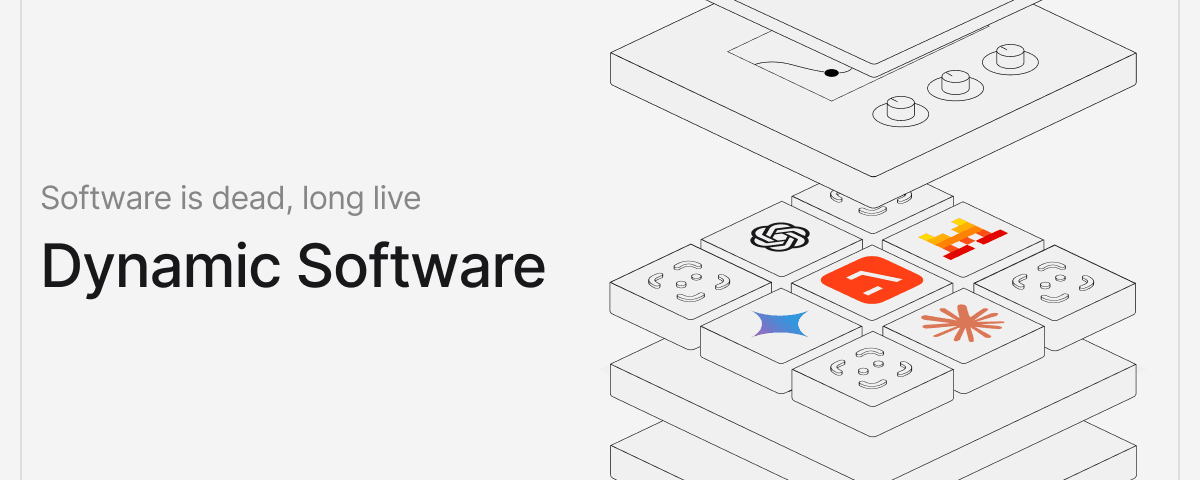
Dynamic Software
For fifty years, software has been static.
Every program you've ever used is a collection of functions run through a hard-coded control flow: If, else, while, for. The functions do the work. Reading from databases. Calling APIs. Transforming data.
Same Input = Same Output. This was the contract for fifty years.
Then 2024 happened. The control flow came alive and created a new category of software. Software that is alive, dynamic, on-demand.
Software is dead, long live Software
Static software is a recording. You press play and you get back exactly what was captured. Same notes, same order, every time. The performance happened once, in a devbox, and now it plays the same tune every time.
Dynamic Software is a live orchestra.
The score exists. The instruments exist. The musicians exist. But what happens in the room tonight depends on the maestro, the players, the moment. The model is the maestro. The tools are the instruments. The control flow is the performance, not the recording.
This is what people feel when they use a great agent and can't quite explain why it feels different. They've spent their whole lives interacting with buttons. Now they're in a room with a live performance for the first time. The software is responding to them, here, now, with judgment and presence. It's listening. It's adjusting. It's alive in a way software has never been alive before.
Recordings are perfect. Live performances aren't. A live orchestra makes choices. Sometimes it stumbles. Sometimes it surprises you. The reason we still pay to hear live music is that something different happens in the room.
The performance is the point.
Dynamic Software is alive. It's not deterministic. It's not perfect. And once you've felt the difference, recordings feel like what they always were. Frozen.
We're not building better recordings. We're building the first generation of software that performs.
Assumptions Dynamic Software breaks
When software comes alive, every assumption built on static software breaks.
Determinism breaks. Same input no longer means same output. The model considers context, memory, learnings. The software does something different on Tuesday afternoon than it did on Monday morning. While this can be (somewhat) controlled in text, we should note that the visual era is next. Charts, dashboards, entire screens generated on-demand. Instead of forcing determinism on non-deterministic software, give in, enjoy the ride.
State and time work differently. Static programs don't need to remember much. The control flow is the same every time, so state lives in a database and is CRUD only. In Dynamic Software, state is context. Memory of past sessions. History of what worked. Knowledge of the domain. The database stops being storage and becomes the context the software runs on.
Sessions follow from this. A static API endpoint is stateless by design. Each request is independent. Dynamic Software is the opposite. A session is a continuous context that spans minutes, days, sometimes weeks. The user comes back, the agent picks up where it left off. Sessions become first-class.
Time changes too. Static software returns in milliseconds, seconds if you don't believe in data co-location. Dynamic Software reasons. It calls tools. It waits for tools to return. It reasons again. A single request takes minutes sometimes. Streaming is the default. Background execution is a core primitive. The HTTP request/response model strains and breaks and so does the default 29s loadbalancer timeout.
The software needs to watch itself. With static software, you can read the code and know what it does. With Dynamic Software, you can't. The control flow is a model and the model is opaque. The only way to know what your software did is to record everything it did. Every reasoning step. Every tool call. Every retrieval. Tracing goes from a debugging tool to the only way to understand your software.
Watching isn't enough. Static programs don't make decisions, so there's nothing to approve. Dynamic Software makes decisions, and decisions have consequences. Some can be made freely. Some need the user. Some need an admin. Your software has to express which is which, and your runtime has to enforce it.
Every one of these is a real engineering problem. Every team building Dynamic Software hits them all. Most spend months solving these from scratch.
A new category needs a new runtime
Static software has a mature runtime. You write Django or Express, deploy to a managed platform, and don't think about HTTP, sessions, scaling, or recovery. The infrastructure is solved. The platform handles it.
Dynamic Software has no equivalent. You write an agent. Then you build six months of infrastructure around it, fixing every edge case manually. Edge cases you only learn after running agents at scale. SSE + websockets. Streaming + background execution. Sessions that survive restarts. Storage you can actually query, not five vendors stitched together. Approval gates that wait for admin sign-off, not just user confirmation. Per-resource, per-tool RBAC. Agents available on Slack, Telegram, WhatsApp, because no one wants to use a custom UI.
This is why 80% of agents don't work, there's a painful amount of grind in the last mile.
The last shift this big was going from desktop apps to web apps. Web software needed its own runtime, its own protocols, its own infrastructure, its own developer tools. We spent two decades building all of it.
Dynamic Software is here. Starting from scratch. Its own runtime. Its own protocols. Its own infrastructure. Its own developer tools.
The next decade
Static software took fifty years to mature. Operating systems, databases, web servers, deploy platforms, observability stacks, identity providers. We forget how recent most of it is. Heroku was 2007. Kubernetes was 2014. Vercel was 2015. The infrastructure we now take for granted is younger than most of the people building on it.
Dynamic Software is at year one.
Whoever builds the runtime, the protocols, the developer tools, the platforms, defines the next era of software. The work ahead is enormous. It is also the most interesting work I've done in the past fifteen years.
Come build with us at Agno.